
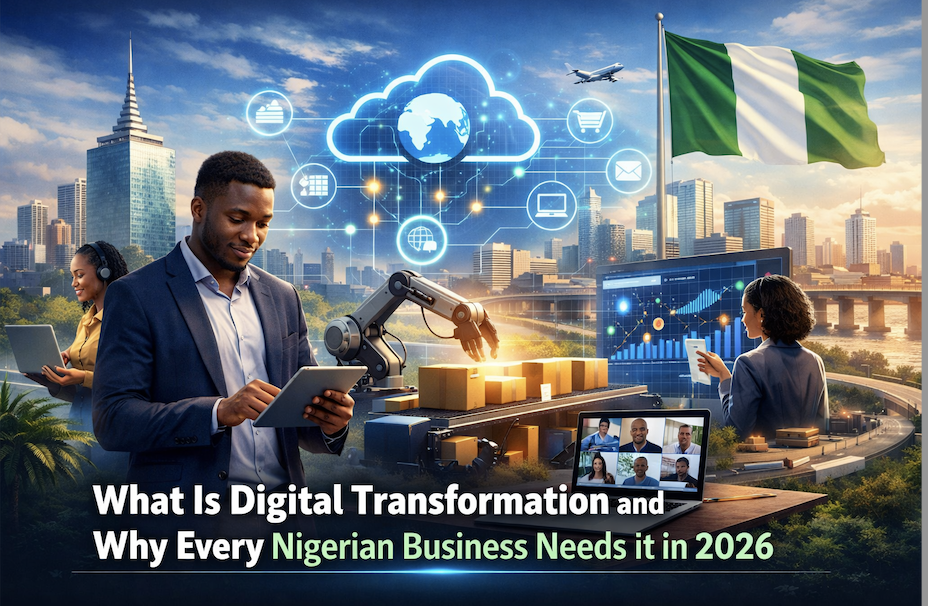
Digital transformation is no longer a buzzword reserved for big tech companies or multinational corporations. As we move into 2026, it has become a practical, business-critical shift that every Nigerian organization—small, medium, or large—must embrace to survive, compete, and grow.
At Bigstar Technologies, we see digital transformation not as a one-time project, but as a continuous journey that helps businesses work smarter, serve customers better, and stay relevant in a fast-changing economy.
What Is Digital Transformation?
Digital transformation is the process of using digital technologies to fundamentally change how a business operates, delivers value to customers, and makes decisions.
It goes beyond simply having a website or social media page. True digital transformation touches every part of a business, including:
- How you communicate with customers
- How your internal teams work
- How decisions are made using data
- How services or products are delivered
- How efficiently your operations run
In simple terms, it is about using technology to do business better, faster, and more intelligently.
Why Digital Transformation Matters More Than Ever in 2026
Nigeria’s business environment is evolving rapidly. Customers are more digital, competition is more global, and margins are tighter than ever. By 2026, companies that fail to adapt will find it increasingly difficult to keep up.
Here’s why digital transformation is no longer optional.
1. Nigerian Customers Are Fully Digital
Today’s Nigerian customer expects speed, convenience, and personalization. From mobile banking to online shopping and instant customer support, digital experiences are now the standard.
Businesses that still rely heavily on manual processes, physical paperwork, or slow response times risk losing customers to more agile competitors who are just a click away.
Digital transformation helps you:
- Offer faster service delivery
- Communicate across digital channels
- Provide seamless customer experiences
- Build trust and long-term loyalty
2. Competition Is No Longer Local
In the past, businesses mainly competed within their city or state. Today, a startup in Lagos can compete with companies in London, Dubai, or Cape Town.
Digital tools level the playing field. A well-digitized Nigerian business can:
- Reach international customers
- Operate remotely and efficiently
- Scale faster without massive overheads
Without digital transformation, many businesses will struggle to compete in this borderless marketplace.
3. Efficiency and Cost Savings Are Critical
Running a business in Nigeria comes with unique challenges—power supply issues, rising costs, and operational inefficiencies.
Digital transformation helps reduce waste and manual errors by:
- Automating repetitive tasks
- Reducing paperwork and physical storage
- Improving inventory and workflow management
- Saving time and operational costs
Over time, these improvements directly impact profitability.
4. Data-Driven Decisions Win in 2026
Businesses that rely on guesswork or instinct alone will fall behind. Digital transformation allows companies to collect, analyze, and use data to make smarter decisions.
With the right digital systems in place, businesses can:
- Track customer behavior and preferences
- Monitor performance in real time
- Identify opportunities and risks early
- Make informed strategic decisions
Data is fast becoming one of the most valuable business assets.
5. Remote and Hybrid Work Are the New Normal
The way Nigerians work has changed permanently. Remote and hybrid work models are now common, especially in tech-enabled industries.
Digital transformation supports this shift by enabling:
- Cloud-based collaboration
- Secure remote access to systems
- Better communication across teams
- Improved productivity regardless of location
Businesses that resist this shift may struggle to attract and retain top talent.
What Digital Transformation Looks Like for Nigerian Businesses
Digital transformation does not mean adopting every new technology at once. For most Nigerian businesses, it starts with practical steps such as:
- Moving from manual records to digital systems
- Using cloud solutions instead of local servers
- Automating billing, customer support, or reporting
- Implementing cybersecurity best practices
- Integrating data analytics into decision-making
The goal is progress, not perfection.
The Cost of Not Transforming
By 2026, businesses that ignore digital transformation may face:
- Declining customer trust
- Reduced competitiveness
- Higher operational costs
- Limited growth opportunities
- Eventual business failure
In contrast, digitally transformed businesses are more agile, resilient, and prepared for future disruptions.
How Bigstar Technologies Supports Digital Transformation
At Bigstar Technologies, we help Nigerian businesses move confidently into the digital future. We understand the local market, the challenges businesses face, and the practical solutions that work.
Our approach focuses on:
- Tailored digital solutions, not one-size-fits-all tools
- Scalable systems that grow with your business
- Training and support to ensure smooth adoption
- Long-term digital strategy, not just quick fixes
Final Thoughts
Digital transformation is no longer about staying ahead—it’s about staying in business. As 2026 approaches, Nigerian companies that invest in the right digital tools, processes, and mindset will be the ones that thrive.
